
The People behind Progress
We are contributing sustainably to people, society and the planet. AstraZeneca goes beyond the medicine and aims to advance the care of patients. Therefore, collaboration is key: collaboration with patients, healthcare professionals, healthcare organizations, governments, non-governmental organizations, academic institutions, businesses... is crucial.
Meet the people behind progress at AstraZeneca and discover what science can do.
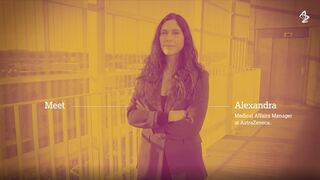
Meet Alexandra
Meet Alexandra Baroni, a scientist who never imagined a career in pharma. With roots in chemical engineering and a PhD in pharmaceutical science, her journey shifted from industry to human impact. At AstraZeneca, her values found their purpose, driving respiratory care that's both groundbreaking and deeply personal.
Ethics made Alexandra choose for AstraZeneca
Alexandra has always been driven by purpose. For her, science and ethics go hand in hand, and any company she worked for had to prove the same. That mindset led her to AstraZeneca, where she joined as Medical Affairs Manager for the Respiratory and Immunology team. During her first conversations with the team, she realized that scientific progress and ethical practice don’t have to be opposites – they can reinforce each other.
Today, she found her calling as a ‘translator of science’ for healthcare professionals, partnering in reflection to integrate new data into patient realities, explore implementation in daily practice, and navigate current challenges together. It’s a role that allows her to combine scientific curiosity with a genuine desire to improve lives. Whether she’s supporting clinical discussions or shaping educational materials, Alexandra sees every project as a chance to bridge the gap between research and real-world care.
Alexandra's proudest achievement is her work on cardio-pulmonary risk in COPD patients: a medical concept that didn't exist until AstraZeneca coined the term. The company transformed an observation into a vision, investing in changing patient outcomes additionally to documenting risks. This global initiative led Alexandra to coordinate a team effort led by multidisciplinary COPD healthcare professionals to develop Belgium's first national COPD recommendation addressing this risk. Work that's deeply personal to Alexandra, as her own grandfather died from the disease.
At AstraZeneca, Alexandra has found the perfect balance between ethical communication and business success. As significant profits 25% flow back into research and development, she's found an organisation that invests boldly in overlooked diseases like COPD. Proof that when ethics and business align, patients are the real winners.
Meet Luc
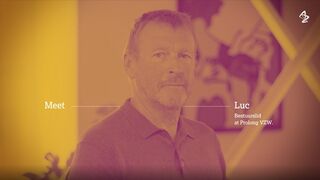
When Luc was diagnosed with lung cancer, he discovered there was no patient organisation in Belgium to support him. Instead of accepting this void, he co-founded Prolong to ensure no patient faces his/her journey alone. He now brings the patient voice into AstraZeneca’s partnership with Prolong.
Luc's legacy of hope in lung cancer care
Luc thought he knew what life had in store for him: family time with his wife, two sons and grandchildren, cycling through the countryside and a rewarding management career. That changed when persistent hoarseness led to an unexpected diagnosis of lung cancer. Because surgery wasn’t an option due to the tumour's location, he started chemotherapy and radiotherapy. When cancer spread to his adrenal gland despite treatment, he faced a difficult period filled with questions and hard choices.
During and after Luc’s treatment, he looked for contact with patients. At that time, there was not yet a patient association specifically for people with lung or pleural cancer. Rather than accepting this void, Luc helped establish Prolong, a patient organization symbolized by a night moth – drawn to light, representing hope – with two figures supporting each other.
What began as a small initiative has quickly grown into the reference organization for people living with lung cancer and mesothelioma. From organizing educational sessions and psychosocial activities to running awareness campaigns and contributing to key policy discussions – such as lung cancer screening – Prolong has become a strong and trusted voice for patients and their families. ‘If screening had existed earlier, I might not have ended up in such a difficult health situation’, Luc shares.
Today, the partnership between AstraZeneca and Prolong strengthens support for people living with lung cancer. Together, they bring patient perspectives into advisory boards, help shape medical innovation, and collaborate on education and awareness initiatives – learning from each other to make a real difference for patients and their families.

Meet Nele
A decade in pharmaceuticals taught Nele how to meet targets and navigate a complex industry. However, her cancer diagnosis at 28 taught her something far more valuable: the true impact of pharmaceutical innovation. Now at AstraZeneca's oncology team, she channels her passion into helping patients fight for their lives.
After cancer: Nele's shift from sales to saving lives
At twenty-eight, Nele had built a solid decade-long career in the pharmaceutical industry. She was good at her job: hitting targets, building trust and moving on to the next objective. But then cancer changed everything. What started as a devastating diagnosis became a profound shift in how she viewed her work and her purpose.
Science became her lifeline. Her oncologist chose to enroll her in a clinical trial using an innovative treatment approach, surrounding her with a team of experts from external pharmaceutical companies. ‘It's because that doctor was so well-informed and supported by such a good team from pharmaceutical companies that he could give me the best possible options’, she reflects. ‘That's why I'm still here today’. The realization that her survival depended on this collaborative network of medical professionals and pharmaceutical innovation planted the seed for transformation.
The transition from patient back to pharmaceutical professional wasn't easy. When a chance encounter at a medical conference connected her with an AstraZeneca colleague who shared a similar personal story, she discovered an opportunity that would transform her career. As a Sales Representative and scientific partner for AstraZeneca's oncology department, she was able to blend her sales skills with her newfound passion for supporting patients through their cancer journeys.
Today, Nele's work centres on being a scientific partner for healthcare professionals and collaborating with them to provide crucial support for patients. From informative booklets that replace inadequate printouts to ensuring doctors have the latest clinical updates, her role has evolved far beyond traditional sales. ‘It’s about how many patients we can help and how we can make their journey a little easier’, she explains. For Nele, every booklet, every information piece and every clinical update means another patient gets the same fighting chance that science gave her.
Meet Stefan
Stefan believes patients deserve a voice in healthcare decisions. Through the Patient Expert Center, patients are trained to become patient experts in their own disease domain. His collaboration with AstraZeneca shows how pharmaceutical companies can meaningfully engage patients to drive better treatments and outcomes.
Stefan gives patients a seat at the healthcare table
After being diagnosed with colorectal cancer, Stefan made a bold decision: to leave his career behind and dedicate himself fully to one mission – integrating the patient voice into every level of healthcare decision-making. What he experienced as a patient became his drive to make sure others could be heard.
Through the Patient Expert Center, patient volunteers are trained to become skilled advocates who can effectively communicate their unique perspectives. No one understands an illness better than the person living with it. Stefan believes that when patients are actively involved in the decision-making process, both patients and the healthcare system benefit.
Since 2021, the Patient Expert Center has trained 250 patient experts, with 160 more currently learning. All of them are individuals with solid educational backgrounds and deep healthcare knowledge. ‘We train competent volunteers who can support other patients and represent patient groups in projects with industry, government and hospitals’, Stefan explains. These experts can contribute to patient education, clinical trial design, real-world evidence generation.
Stefan's collaboration with AstraZeneca shows how pharmaceutical companies can meaningfully engage patient voices. AstraZeneca brings the voice of patients into the organization by engaging patient experts in internal events, co‑creating educational materials, amplifying patient perspectives in panel discussions and collaborating on initiatives shaping the future of healthcare.
Central to Stefan's vision is disease-specific planning: dedicated strategies for each condition rather than generic approaches. His mission extends beyond individual support to systemic change that benefits everyone. ‘The more we let our voices be heard, the more we are listened to, the better healthcare will become’, he emphasizes. By strengthening patient expertise and joining forces with government, hospitals and companies like AstraZeneca, Stefan is advancing a healthcare future shaped by those it serves.

NS ID XL-5750-Revision date 11/2025-WEB Local code: 2278
Join AstraZeneca today
and help deliver life-changing medicines as part of our innovative team, driving us to be a global leader in the biopharmaceutical industry.